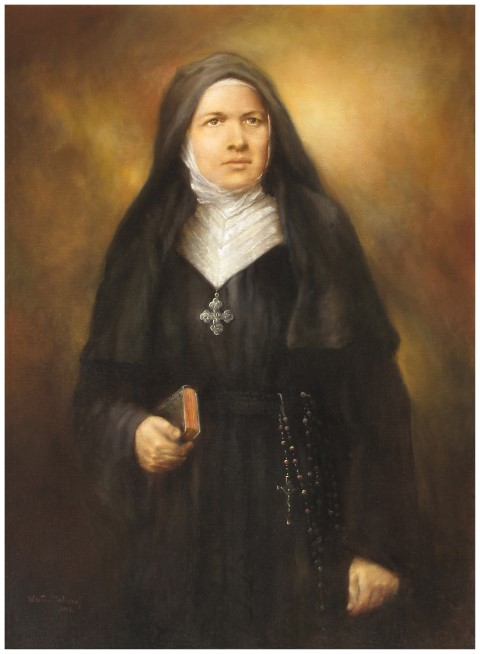
JADWIGA BORZĘCKA
She was born on February 1, 1863, in Obrębszczyzna near Grodno, on the estate of her parents, Józef and Celina Borzęcki. Her family home was the first school where the young girl learned, above all, about love—a love that was demanding yet patient and faithful. Her father’s illness and his slow decline played a significant role in this; in 1869, Józef Borzęcki was struck by paralysis. Five years later, despite various treatments and the devoted care of his wife and daughters, he passed away on February 13, 1874. Jadwiga and her older sister, Celina, were now alone with their mother.
In 1875, Celina and her daughters traveled to Rome. There they met Father Piotr Semenenko, the Superior General of the Resurrectionists. He recognized in the mother a person suited to establish a new female religious congregation living out the charism of Christ’s Resurrection. He became a spiritual guide for Jadwiga, shaping the course of her life. Her older sister, Celina, sensing a vocation to married life, married Józef Haller in 1879 and settled first in Giebułtów and later in Obrębszczyzna.
On April 20, 1876, Jadwiga received her First Holy Communion in the chapel of the Sisters of Reparation in Rome. From that moment on, Jesus—her dearest and long-awaited Guest—became her Friend and her sole Happiness.
Jadwiga sought the path of her vocation. On March 25, 1881, following a retreat led by Father Piotr, she resolved to stand by her mother’s side and assist in the work of founding the Congregation of the Sisters of the Resurrection. On January 6, 1891, she gave her eternal "YES" to the Lord, embracing a life of chastity, poverty, and obedience. She stood beside Mother Celina, always ready to shoulder a burden, offer help, or address a need.
As the Congregation grew, she devoted herself to it wholeheartedly. Rome, Poland, America... Superior, novice mistress, mother...
Her life was a reflection of the words inscribed on the sisters' profession crosses: *Per crucem et mortem ad resurrectionem et gloriam* (Through the cross and death to resurrection and glory). She passed away on September 27, 1906, in Kęty—in the very house that served as the cradle of the Congregation on Polish soil.
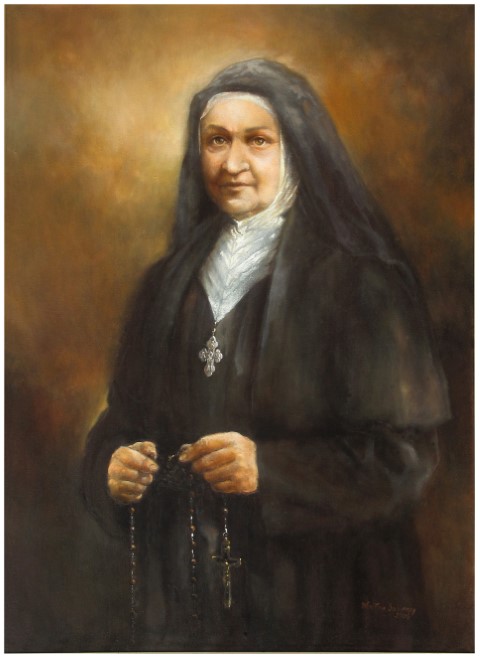
CELINA BORZĘCKA (NÉE CHLUDZIŃSKA)
She was born in 1833 in Antowil, near Orscha, in the Mogilev region—territories that had belonged to Poland in the eighteenth century. The characters of the three children—Filipina, Alojzy, and Celina—were shaped under the guidance of their exemplary parents, Ignacy Chludziński and Klementyna (née Kossowska). Their affluence did not prevent the parents from raising their children to respect work; they instilled in them a sense of conscientiousness in fulfilling their duties. Diligence, truthfulness, and obedience were required of the children. Love for one’s neighbor was not merely spoken of but actively practiced. The children were also raised in a spirit of wise and profound patriotism. In the Chludziński household, love for the Homeland held the place of honor, second only to the love of God.
Celina began thinking about God at an early age and, from childhood, showed an openness to spiritual matters. She devoted herself to prayer with great zeal. She held a special devotion to the image of Our Lady of the Gate of Dawn (Ostra Brama). She would spend long periods there conversing with Mary, and it was there that she ultimately realized her desire to dedicate her life to God in a religious order. She was devastated when she learned of her parents' decision regarding her marriage. In keeping with the custom of the time, a husband had been chosen for her and the wedding date was set.
On the verge of a breakdown, Celina felt a deep desire to make a spiritual retreat. Fixing her gaze on the figure of Mary and pondering her "fiat," she too uttered the words, "let it be done to me." She cherished deep within her heart a desire to dedicate herself exclusively to God; obedient to the will of her parents and her confessor, and tempered by the suffering she had endured, she stood ready for new tasks. It was then that she revealed the most characteristic trait of her spirituality—one that would mark her until the very end of her life: a love for God’s will above all else.
Celina’s marriage to Józef Borzęcki was a very happy one. Józef took his wife to his estate in Obrębszczyzna (near Grodno) and surrounded her not only with respect and love but also with material comfort. God blessed them with four children, two of whom died in infancy. Two daughters—Celina and Jadwiga—survived. The children became the focus of the Borzęckis' deepest care and affection. Having themselves been raised in an exemplary manner by their own parents, Józef and Celina needed no outside advice; they successfully employed the same child-rearing methods with their own children that they had experienced in their own childhoods.
The earthly happiness Celina found in her marriage did not mean a life free from suffering. In 1869, Józef Borzęcki suffered a paralytic stroke that caused him to lose the use of his legs and confined him to a wheelchair. It became evident once again that Celina’s consent to the marriage was not merely an outward act of compliance—on the part of a twenty-year-old young woman—with the wishes of her parents and confessor. Celina truly believed that marriage was God’s calling for that stage of her life. Just as she had previously embraced the roles of wife and mother with total dedication, she now took on the role of a most devoted and patient nurse. However, medicines, medical procedures, and expensive treatments proved insufficient. Józef Borzęcki died in Vienna in 1874 at the age of 52.
After settling her financial affairs, Celina traveled to Italy. Her long-held desire to dedicate herself to God was rekindled. In Rome, Celina came into contact with the Congregation of the Resurrection. Their Superior General, Fr. Piotr Semenenko, became the spiritual director for both Celina and her younger daughter, Jadwiga; the elder daughter, also named Celina, soon married Józef Haller.
Fr. Semenenko, who had for years sought to establish a female branch of the Congregation of the Resurrection, recognized that Celina—possessing a religious vocation—was ideally suited for this purpose. He proposed that she head the future congregation. In 1881, Jadwiga joined her mother, and together, under Fr. Semenenko’s guidance, they laid the foundations for a new religious family rooted in Resurrectionist spirituality. For eleven years (1875–1886), Fr. Piotr instructed his spiritual daughters in the path of Paschal spirituality. He guided them toward an ever-fuller union with God. He pointed to the necessity of living in communion with Christ through total surrender to God-Love—a trust pushed to its absolute limits. The expression of this boundless trust in God is the total offering of oneself to Him. He offered encouragement and courage, revealing the truth about human frailty and the necessity of dying to self and rising again.
The Congregation of the Sisters of the Resurrection of Our Lord Jesus Christ was officially established within the Church (January 6, 1891). That same year, Mother Celina arrived in Poland and began construction of a novitiate house in Kęty, near Oświęcim. In 1896, at the request of the Resurrectionist Fathers, the sisters opened a mission in Bulgaria, followed by another in the United States in 1900.
Standing by Mother Celina’s side was her faithful and devoted daughter, Jadwiga—a pillar of support for her aging mother. On September 27, 1906, Jadwiga was suddenly—and without warning—called to eternity. Mother Celina stood over her child’s lifeless body like a statue of grief turned to stone. This terrible blow shook Celina deeply, yet it did not break her. With heroic fortitude, she embraced the suffering sent to her and, once again...